Dorothy Ker discusses the evolution of her work
The first version of the piece (performed in Wellington and Beijing) is called String Taxonomy. In composing for this hybrid ensemble of stringed instruments, I aimed to develop a taxonomy, or vocabulary, of gesture and timbre that was shared amongst the four instruments. What new sound world was possible with this novel combination of instruments? How could the four instruments become ‘one’- a ‘hyper stringed instrument’?
This approach generated a composite fabric of sound in which no one instrument is isolated: instead, all four become instruments that pluck, bow, strum and bend together.
The process was a gradual one, working with each instrument in turn (and specifically in ‘play’ sessions on guzheng with Shu Jiang), in which I became aware of the way the different timbres in my thinking ‘infected’ one another: guzheng becomes a bowed instrument at times, and so does the piano; violin, cello and piano become ‘bending’ instruments; all instruments pluck and strum, and also develop percussive qualities. Many of these draw on existing techniques and experiments (not least my earlier work for Trio Onaia), but the ways they are assembled here is about cohesion, both timbrally and gesturally.
Some of the techniques require a high level of co-ordination (changing tools, striking in exact synchronisation) and shared problem-solving (how to execute sounds most effectively to produce the composite effect), which enhances the cohesion of the group. (Guzheng player Xia Jing commented to me more than once that she feels my work understands the ‘chi’ of ‘tai chi’—in other words the way the music breathes feels familiar: this chi must be shared by the whole ensemble.)
Of all the ‘infections’ that this new instrument—the guzheng—brought to my imagination for this ensemble, the bending was the most enchanting and seductive, both timbrally and as a primary gesture of the instrument. (The cello can imitate this quite easily, but it is much more challenging for the violin due to being a much smaller instrument with less resonance. The piano does it beautifully using a heavy metal object to slide on the string.)
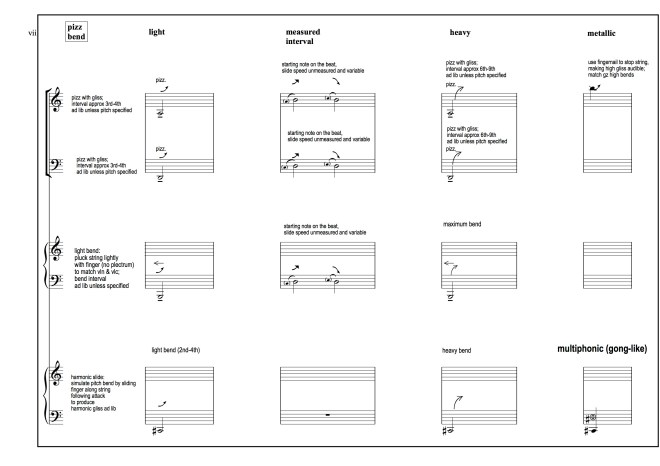
In revising the piece to become Time Bends in the Rock I make a new version in which the lyrical elements of the bending are stronger—the guzheng leads at the opening and in the final, more contrapuntal/melodic (and virtuosic for the guzheng) section, incorporating the main features of String Taxonomy, but now releasing the expressive vision of the piece more fully.
 Silk Dialogues 絲的對話